Loading video…
All breakouts

4.5Talking HeadStory Open hook
Hook
so imagine you
@growwithpolina
9.0K followers · usually 837 views a post
Views
3.7K
Likes
255
Comments
5
Shares
21
Why it worked
The video provides practical, actionable advice for a common workplace problem, offering a clear framework for leaders to diagnose and address team resistance. The structured approach with numbered scenarios makes the information easy to digest and apply.
Summary
The video explains three reasons why a team member might say "no" to a new process: a skill gap (requiring coaching), a standards issue (requiring clear expectations), or a lack of understanding (requiring explanation of the process's purpose). The speaker emphasizes the importance of diagnosing the root cause to effectively address resistance and maintain standards.
Structure
- 1Introduce a new process, team says no
- 2Scenario 1: Skill gap (coach them)
- 3Scenario 2: They know how but won't (standards conversation)
- 4Scenario 3: Don't understand the 'why' (explain the purpose)
- 5Leaders often skip diagnosis, leading to eroded standards
On-screen text
Things I do when my team says "no"
(as a fractional COO)
Transcript
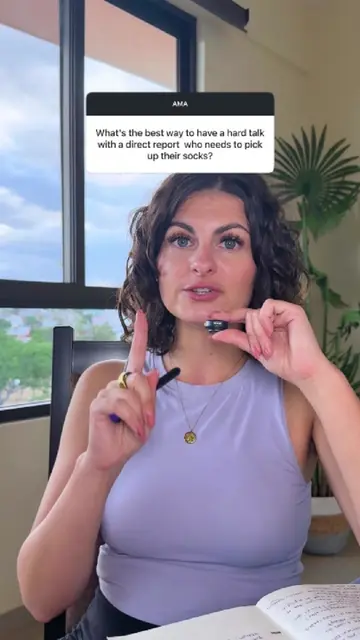
so imagine you introduce a new process and then they say, yeah, I'm not doing that. There's actually one of three things that might be happening that's creating that kind of response. So let's dig into it. The first scenario is a skill gap. They say they can't because they don't know how and this is a situation where you actually just need to coach them through it. You say something like, let's walk through it together the first time, and then moving forward, I expect you to take this on and run with it without me. So you do the one rep, hold the standard. The second scenario is that they know how, they just won't. It's actually a standards conversation. So you can say, I'm open to feedback on the process, but "I'm not doing it" isn't one of the options. This is how we're operating moving forward, and I need you to comply with that process. And if the behavior continues after that, then it's no longer a coaching conversation, or a process problem, it is a fit problem. The third scenario is that don't understand why this process exists. They don't understand the purpose behind it. They feel like it's pointless bureaucracy. Talk them through it and explain how it fits into the bigger picture, why it's important, why it helps them. Ultimately, sometimes they may not agree, but the work still needs to get done. And so if they still get the why, but they refuse, it becomes a fit problem. Most leaders skip this diagnosis of where the no is coming from, because it feels like you're making the situation bigger than what it needs to be, but you're not. This is exactly how standards erode. The rule might be very small, but it's about how the precedent and enforcing standards, and that part of it is a big deal that you need to say on top of and make sure you follow through every single time with your team.
Original caption
Most leaders hear "I'm not doing that" and panic ...and either back down or skip straight into a disciplinary conversation. Both miss the point 😬 Before you do anything, you need to figure out where the "no" is actually coming from. There are three very different things driving it, and each one needs a different response. 1️⃣ They can't (skill gap) They're not refusing. They just don't know how yet. This is a coaching moment. ...Walk through it with them once, then hold the standard moving forward. One rep, and then you let them run with it. 2️⃣ They won't (will gap) They know exactly how. They're choosing not to. This is where you have the direct conversation: → "I'm open to feedback on the process. But not doing it isn't one of the options." If the behavior continues after that, it's no longer a process problem. It's a fit problem. 3️⃣ They don't get why (context gap) They think it's pointless. They don't see how it connects to anything bigger. Walk them through the purpose, why it matters, how it helps them. (And if they still refuse after getting the why... see number two.) Most leaders skip this diagnosis because it feels like you're making the situation bigger than it needs to be. You're not. This is how standards erode. The rule might be small. The precedent you're setting around it is not. 👉 Follow @growwithpolina for real-world leadership tools and strategies that actually work 💾 Save this for the next time you get pushback on a new process #teambuilding #hiringprocess #smallbusinessowner #businessgrowth #entrepreneur
More from @growwithpolina
Their other posts in the index, biggest breakout first.