Loading video…
All breakouts
33.0Talking HeadHow-To hookEducation
Hook
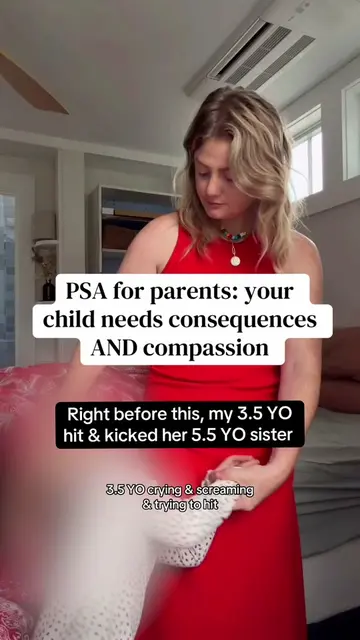
Watch me give my 3 YO a "time in" for hitting her big sis instead of a time out
@kendraworth
309.8K followers · usually 16.5K views a post
Views
423.2K
Likes
53.6K
Comments
447
Shares
3.6K
Why it worked
The video effectively demonstrates a gentle parenting technique by focusing on emotional regulation and empathy rather than punishment. The creator's calm guidance and clear explanations resonate with viewers seeking alternative discipline strategies, making it relatable and shareable.
Summary
A mother demonstrates a "time in" approach to discipline for her 3-year-old who hit her sister. The mother guides the child through understanding the difference between an accident and a mistake, processing her anger, and expressing genuine remorse to repair the relationship with her sister.
Structure
- 1Child hits sister, mother initiates "time in".
- 2Mother explains why "time outs" are ineffective.
- 3Mother guides child to differentiate between accident and mistake.
- 4Mother helps child identify and process anger.
- 5Mother explains the importance of genuine apologies for relationship repair.
- 6Child expresses remorse and willingness to apologize to sister.
On-screen text
Watch me give my 3 YO a "time in" for hitting her big sis instead of a time out
You need to come in here with mommy.
Time outs are no longer recommended for discipline
*3 YO sobbing: I'm sorry, I'm sorry!*
This is because time outs make a child feel abandoned & rejected
Would you like to come sit on my lap or sit across from me?
3 YO: I want hugs in your lap
And they don't teach the right lesson
3 YO: I want hugs in your lap
So what happened?
INSTEAD of a child being focused on what they did wrong & how to change it in the future, they're focused on the stress they feel that their parent no longer loves them
3 YO: I hit her by accident!
3 YO: I hit her by accident!
Are you telling the truth, Noelle?
Cause I want. I need to hear the truth.
So instead of leaving her alone in a "time out", we have a "time in" together
Because Zoe seems to think you took the half of the toy egg
I NEVER withdraw love & affection as part of a consequence, but my children always have consequences
3 YO - But I just had it!
3 YO - But I just had it!
If my child is calm enough, we start with a discussion about what happened
Do you know what accident means?
It means like you slipped and you did it
and you didn't mean to at all.
It sounds like you were mad and so you
and you had the egg so you hit with it.
Is that what happened?
3 YO: mmhmm
So it wasn't an accident, right?
It was on purpose?
3 YO: No, it was an accident!
I think you mean it was a mistake.
Because it was a mistake for you to do that.
But you did it on purpose.
You meant to hit her, didn't you?
3 YO: okay, I'm sorry!!
Reminding her that she hit her sister on purpose brought up a lot of feelings
3 YO: okay, I'm sorry!!
You're sad about that?
It was a mistake. It was something you shouldn't have done.
3 YO: I'm sorry!
You're very sorry?
Now why are you sorry?
Then I want to make sure she's feeling guilty about hitting & not guilty because she's receiving a consequence
3 YO: Cause I hit Zoe!!
3 YO: Cause I hit Zoe!!
Are you sorry because mommy's talking to you?
Or are you sorry because that hurt her?
3 YO: I'm sorry that I hurt her!!
Now we're talking about her big sister's feelings when she hit her
You're sorry cause you hurt her?
What do you think she was feeling when you hit her with that?
3 YO: Sad
Sad?
Yeah. Do you want to make Zoe sad?
3 YO: No!
No, you're a kind girl, right?
No, you're a kind girl, right?
I always affirm that my children ARE kind and gentle (even if they aren't acting like it)
Who's my kind and gentle girl?
Because what they believe about themselves is who they will become
You are.
What else were you feeling when you hit her?
Sad and angry
Sad and angry?
Yeah, you were feeling angry.
But what do we do when we're feeling mad or angry?
And talking about different strategies for managing anger WITHOUT hurting anyone
What do we do with that feeling in our body?
Should we hit people with stuff like boom
3 YO: No.
What can we do when we have that feeling in our body?
Tell me what we can do instead.
3 YO: I'm mad.
Say I'm mad.
Say Zoe. Don't do that.
Zoe, I'm playing with that.
Use our...
Our words
If we need to hit something,
what can we hit?
3 YO: The couch.
The couch or...?
The bed.
You made a mistake.
After talking everything out, I let her know that she needs to take a break from playing (the time in) as her consequence
Now you're gonna take a little break from playing in this room with me.
I'm gonna sit here
and you're gonna take a little break from playing with sisters.
Some parents mistakenly believe staying with them & giving them "attention" will feel like a reward
Because you have to have a consequence when you hit.
3 YO: Okay, but I really wanna see Zoe.
But clearly my 3 YO does NOT want to take a break from playing & doesn't see this as a reward
3 YO: Okay, but I really wanna see Zoe.
You wanna see Zoe?
Are you feeling sad that you hurt her?
Sobbing: I want to say sorry!
By the end of our conversation, she's begging to go say "sorry" to her sister without me having to force an apology
You wanna say sorry?
3 YO: ah huh
Oh, I bet.
And that's what you want! Apologies should come from genuine remorse
You know what I think will happen when you say sorry?
I think that's gonna help Zoe feel a lot better.
I always focus on how her apology will help repair the relationship
I think that's gonna help her forgive you.
Original caption
Most parents today grew up being told to “go to their room to think about what they did wrong” and take a time out. But time outs are not an effective form of discipline because number 1, a young child is incapable of that type of self-reflection without an adult guiding them. Number 2, they are focused on the WRONG things during the time out. Instead of being able to reflect on their natural guilt for what they did wrong, their cognitive resources become hijacked by their distress that their parent no longer loves them (because affection & attention are synonymous with love to a child). This breeds resentment not only toward their parent, but also whoever they view as the cause for the time out, which in this case would be her big sister. And sibling resentment is the OPPOSITE of what I want. Staying with your child and offering support is NOT a reward for misbehavior. You can clearly see that my child was upset that she had to take time away from playing. And logically, wouldn’t kindness and compassion be the best example to show them if that’s what they’re struggling with? Why would cruelty and rejection help a child be MORE caring? My girls are thriving with “time ins” and my oldest is such a considerate & loving child, and my 3 YO is also wonderful, but still has her moments. I know she’s going to get there, especially now that the true empathy milestone is starting to kick in (this happens between 3 and 5) 💗 Make sure to follow me for all things REAL life evidence-based parenting & no-tears sleep training and head to the 🔗 in my bio or hhsleep.com for more resources #momtok #timeout #timein #momshelpingmoms #creatorsearchinsights Why I do a time in instead of a time out What’s a time in Time out putting kids in time out
More from @kendraworth
More breakout videos from this creator.